Assessing CRM Maturity to Build a Scalable Growth Strategy
The Challenge
As the business continued to grow across multiple brands, its CRM function had become increasingly complex. New tools had been introduced, teams had expanded, and campaign volumes had increased, but leadership lacked a clear understanding of where the CRM capability stood compared to industry best practice.
The organisation wanted to answer several key questions:
- Is our CRM operating model fit for future growth?
- Are we using our technology investment effectively?
- Where are the biggest capability gaps?
- Which improvements will deliver the highest commercial impact?
Rather than immediately investing in new technology or restructuring the team, the business wanted an independent assessment of its current maturity.
The Approach
I led an end to end CRM maturity assessment, combining stakeholder interviews, process reviews, platform analysis and capability benchmarking.
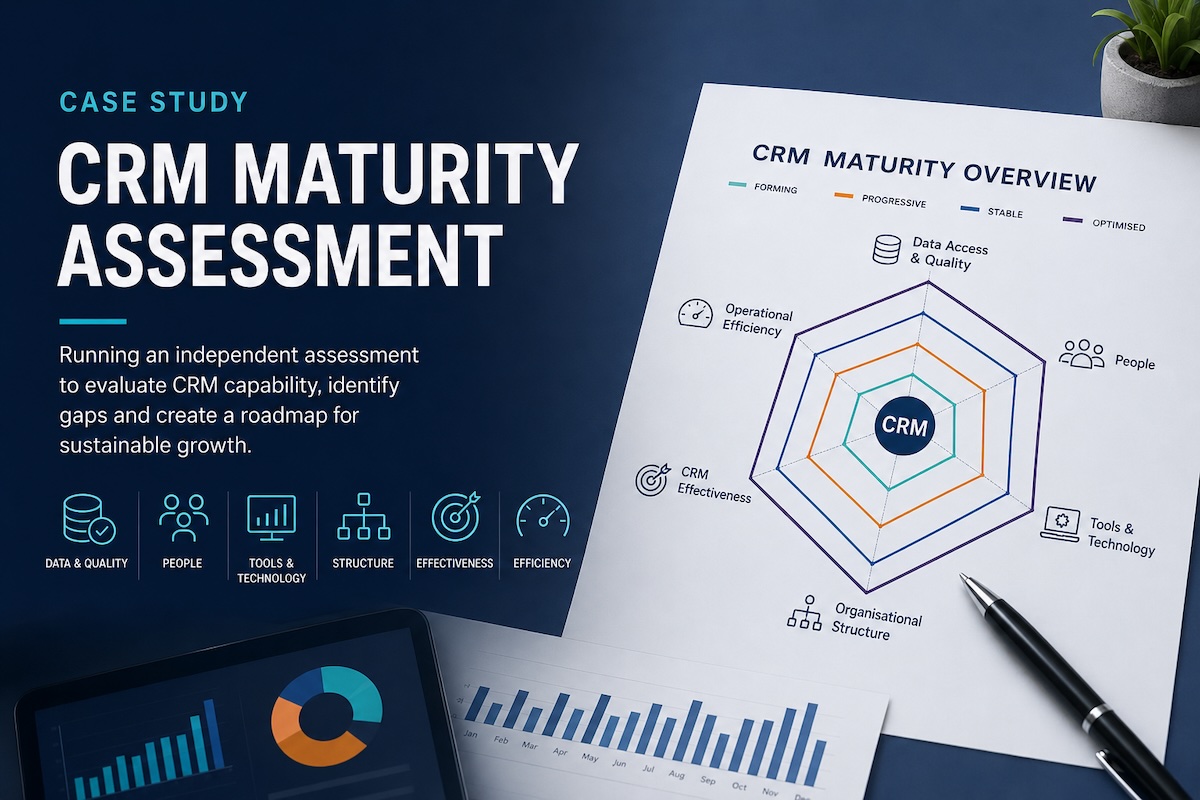
The assessment evaluated six core dimensions of CRM maturity.
1. Data Access & Quality
Reviewed the availability, quality and accessibility of customer data, including:
- CRM data readiness
- Integration with key platforms
- Automation of data flows
- Data governance
- Reporting accuracy
2. People
Assessed the organisational capability required to deliver an effective CRM programme.
This included:
- Leadership and strategic direction
- CRM planning capability
- Campaign execution skills
- Technical CRM expertise
- Automation capability
- Resource structure
3. Tools & Technology
Evaluated whether the technology stack was enabling growth or creating unnecessary complexity.
Areas reviewed included:
- Platform capability
- Tool architecture
- Technology utilisation
- Cost efficiency
- Integration maturity
- Automation opportunities
4. Organisational Structure
Reviewed how the CRM function interacted with the wider business.
Including:
- Team design
- Commercial alignment
- Ownership of customer journeys
- Decision-making processes
- Governance
- Cross-functional collaboration
5. CRM Effectiveness
Measured how effectively CRM activity translated into commercial results.
The assessment covered:
- Campaign planning
- Personalisation capability
- Lifecycle management
- Reporting maturity
- Insight generation
- Performance optimisation
6. Operational Efficiency
Analysed the processes supporting campaign delivery.
Including:
- Work intake
- Prioritisation
- Delivery timelines
- Stakeholder collaboration
- Capacity planning
- Workflow efficiency
The Assessment Framework
Each capability area was independently scored against a 4 stage maturity model:
| Level | Description |
|---|---|
| Forming | Processes are largely manual with limited governance and automation. |
| Progressive | Core capabilities are established, although consistency and scalability remain challenges. |
| Stable | Well defined processes supported by appropriate technology and governance. |
| Optimised | Continuous improvement culture with advanced automation, personalisation and data driven decision making. |
This created an objective baseline that leadership could use to prioritise future investment.
Key Findings
The review identified several recurring themes.
Strong Foundations
The CRM team demonstrated strong commercial knowledge, experienced leadership and an established campaign delivery process.
Opportunities to Improve
The biggest opportunities centred around:
- Better integration between CRM and customer data sources
- Increased automation of data delivery
- Simplifying the CRM technology architecture
- Improving utilisation of existing platform functionality
- Standardising planning and governance processes
- Enhancing reporting to better measure incremental performance
Importantly, many of the recommended improvements required better use of existing technology rather than investment in additional platforms.
Recommendations
Following the assessment, I produced a prioritised roadmap covering short, medium and long-term initiatives.
The roadmap included:
- CRM operating model improvements
- Data integration priorities
- Technology optimisation opportunities
- Team capability development
- Governance framework
- Measurement strategy
- Automation roadmap
- Personalisation maturity plan
Each recommendation was assessed based on business impact, implementation effort and expected return on investment.
Looking to assess your CRM capability?
Whether you’re scaling an existing CRM function or reviewing your current operating model, an independent maturity assessment can quickly identify where the biggest opportunities for growth exist.
Get in touch to discuss how a CRM maturity assessment can help your organisation improve customer engagement, operational efficiency and long term commercial performance.